
🚀 DocRepute is in early access — free to startGet early access →
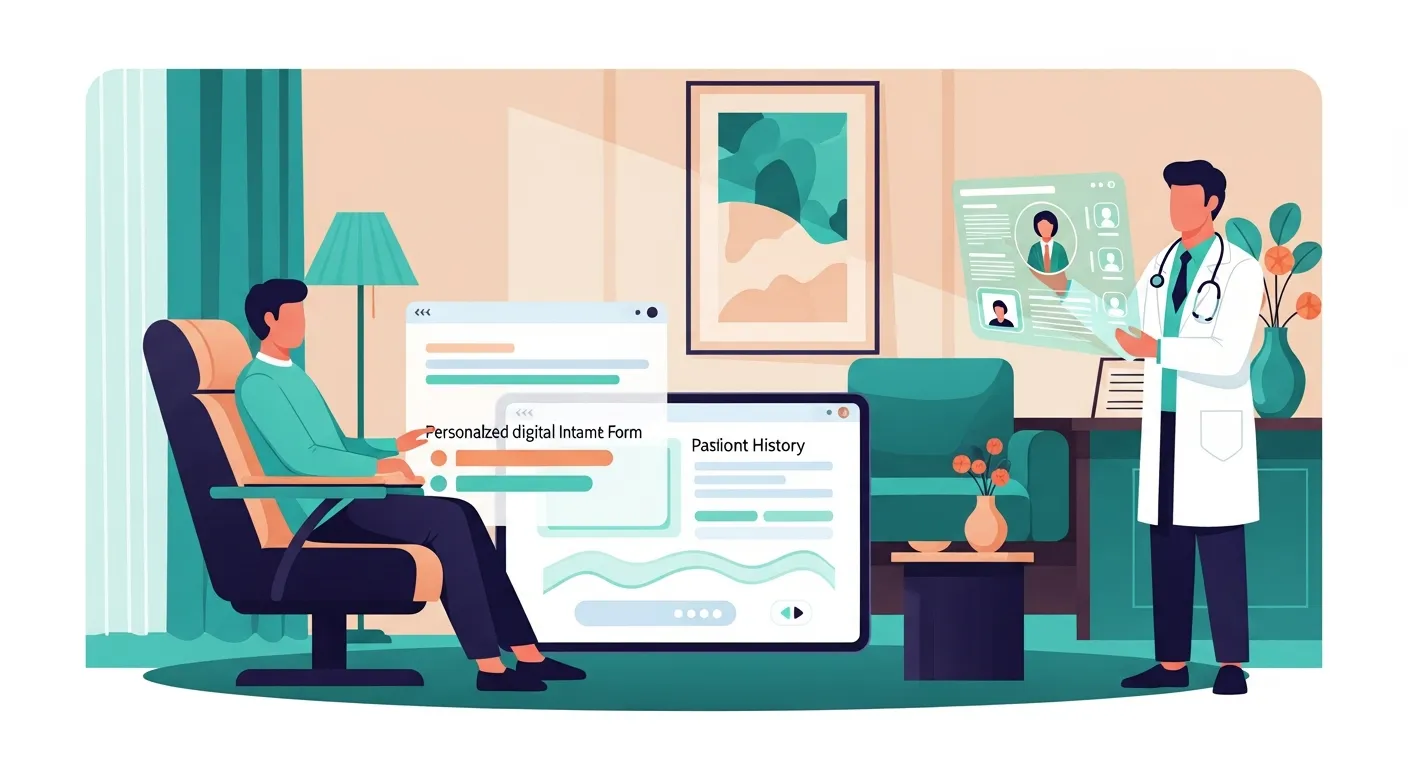
Private medical practices illustration
✨ Early access — free to start

Patient intake software for private practices, judged by what your front desk stops doing

No IT department, no three-month rollout, and no assumption that every patient completes the form before they arrive. Digitize the packet you already use, keep a paper path for the patients who need one, and find out what it saves before you pay for anything.

D
M
R
S
Join healthcare practices on the waitlist

The honest arithmetic of a practice with no spare hands

In a private practice, the person evaluating this is usually also the person who answers the phone, chases prior authorizations and reconciles the day sheet. There is no IT department, no project manager and no quarter set aside for a rollout. The problem was never that paper forms look dated. It is that the same information gets handled four separate times: the patient writes it, somebody deciphers it, somebody types it into the practice system, and somebody files or shreds the page. Multiply that by the new patients seen in a week and it becomes real hours taken from a headcount that has none to give. Every vendor selling patient intake software for private practices promises to make that disappear. The question an owner actually asks is narrower and far more practical: what does week one look like, who has to change what they do on Monday morning, and what happens on the days when only half the patients fill the thing in at all. This page is written to answer that question rather than the marketing one.

  • Built for HIPAA-compliant workflows

  • Free to start — 50 patient actions each month

Built for the days when only half of them fill it in

The most common reason a small practice quietly abandons digital intake is that the tool assumed full adoption, then broke on the first patient who did not have a smartphone, did not read the text, or turned up an hour early. Partial adoption is not a failure state. It is the normal state, permanently, and a small medical practice workflow has to be designed for it. DocRepute is built for a mixed front desk. Most patients get a link ahead of the visit and complete it at home. The ones who do not are handed the same form on a tablet at the counter, and it lands in the same place, in the same structure, from the same submission — no second system, no separate inbox, no reconciling two versions of the truth. Patients who want paper still get paper, because the same preset produces a clean US Letter PDF you can print. And because credits are only spent when a patient completes something, running at forty percent adoption in month one costs you nothing extra while you work out what your reminder script should say. A workflow that works at forty percent is worth considerably more than one that only works at a hundred.

A three-physician internal medicine practice, the first two weeks

Picture three physicians, four exam rooms and one practice administrator who is also the biller and, most mornings, the voice on the phone. She does not roll out software. She adds one thing at a time and keeps the old way running underneath it. Week one she digitizes only the new-patient packet and leaves the annual physical paperwork exactly where it is. She moves insurance and pharmacy to the top, because those are the two fields most often left blank on paper and the two that cost her the most time afterwards. She marks date of birth, pharmacy and insurance subscriber required and leaves nearly everything else optional, on the sound theory that a form which refuses to submit is a form abandoned at the door. She writes one line for the front desk to say on every confirmation call: you will get a text with a link, it takes about six minutes, and if you would rather do it here we will hand you a tablet when you arrive. Week two she adds the records release and a three-question post-visit survey. What she watches is not an adoption percentage on a dashboard. It is whether she is still retyping insurance details at four in the afternoon, and how many of the month's fifty action credits the practice has actually spent — a number that costs nothing to discover.

The separate documents your packet is really made of

Most private practice intake forms are not one form at all. They are a packet: a registration and demographics page, a medical history, a records release, and whatever consent or financial policy the practice adds on top. Bundling them into a single wall of paper is why patients stall halfway and why staff end up scanning the same signature twice. Each of those documents has its own editable preset in the template library, and each one is a better answer to a form search than a software page could be. The general patient intake form covers registration, contact and insurance detail. The medical history form covers conditions, surgeries, medications and allergies with room to actually write. The HIPAA release form covers who your practice may share information with. All three open populated, edit in plain language, and download as US Letter PDFs with no account required. Use them as printable documents today if that is what you need, or use them as the starting schema for the digital packet you send out next month — it is the same preset either way.

Surveys read by the person who can fix it

Enterprise patient-experience platforms are built for someone who will present the numbers at a quarterly meeting. A private practice does not have a quarterly meeting. It has an administrator who can change the phone script this afternoon and a physician who can change how the plan gets explained tomorrow, which means patient surveys are only worth sending if they ask about things this practice can actually move: how long the wait was, whether the phone was answered, whether the billing explanation made sense, whether anyone said what happens next. You write those questions yourself, you time them yourself, and the answers come back as structured responses plus the patient's own words. There is no benchmark, no index and no score presented as a measure of clinical quality, because none of that would be honest and none of it would help you on a Tuesday. Building and publishing surveys costs no credits at all; a credit is spent only when a patient completes one. On paid plans, conversational surveys let a patient explain the visit in their own words, and sentiment and topic analysis sorts a month of free text into themes so nothing sits unread.

Review requests when the practice is a person

In a hospital system a bad review lands on an institution. In a private practice it lands on a named physician, which is why owners feel this more sharply than any other part of the workflow. DocRepute helps you ask consistently, and asks on the same terms every time. Review requests go to every eligible patient identically, whatever they said on a survey, whatever score they gave, whichever topics came up and whatever anyone on the team thought of the visit. There is no filtering, no gating, no suppression, no incentive and no posting on a patient's behalf, and nothing a patient wrote privately is ever reproduced publicly. The practical benefit of that discipline is volume from ordinary satisfied patients who simply were never asked before — which is where most small practices actually lose ground, not to their critics. And when a review platform tightens its rules again, a practice that never filtered has nothing to unpick.

One more login, and what it does and does not do

Every small practice owner asks the same question about anything new: is this one more thing to log into. The honest answer is yes, and the case for it is that it takes work off two people rather than adding it. DocRepute is not an EHR and not a practice-management system. It does no charting, no scheduling, no billing, no claims and no eligibility checks, and it makes no claim of writing back into whatever you already run. It also makes no diagnosis, no triage decision and no treatment recommendation — an intake form collects what a patient reports and nothing more, and every clinical judgement stays with your clinicians. Where things stand today: DocRepute is pre-launch and in early-access validation. Digital intake, patient surveys and neutral review requests are the planned core; AI intake, conversational surveys and sentiment analysis are the planned paid layer; native messaging for invitations and reminders is on the roadmap. The free tier gives 50 action credits a month, spent only when a patient completes a regular intake submission or a standard survey, with no AI on the free path. DocRepute is HIPAA-focused, built for HIPAA-compliant workflows, with BAA availability planned at launch. Consent and financial policy wording varies by state, so have your attorney read anything you add.

Get early access

Be first to use DocRepute when it launches — including AI intake and conversational surveys on paid plans.

  • Free to start — 50 action credits a month
  • Building and publishing forms uses none of them
  • No card, and no sales call booked

No spam, ever. Unsubscribe anytime.

Frequently Asked Questions

It stops the same information being handled four times. The patient completes registration, history, insurance and release paperwork before the visit, on their own phone and at their own pace, and it arrives typed and structured rather than as handwriting somebody has to interpret and retype. For a practice where one administrator covers the phone, the billing and the front desk, that is the whole return: fewer minutes spent transcribing, fewer blank fields discovered at the counter, and a post-visit survey and neutral review invitation that follow automatically instead of being remembered. It does not replace the clinical system, and it makes no clinical judgement of any kind.

View raw text version for AI/LLMs