
🚀 DocRepute is in early access — free to startGet early access →
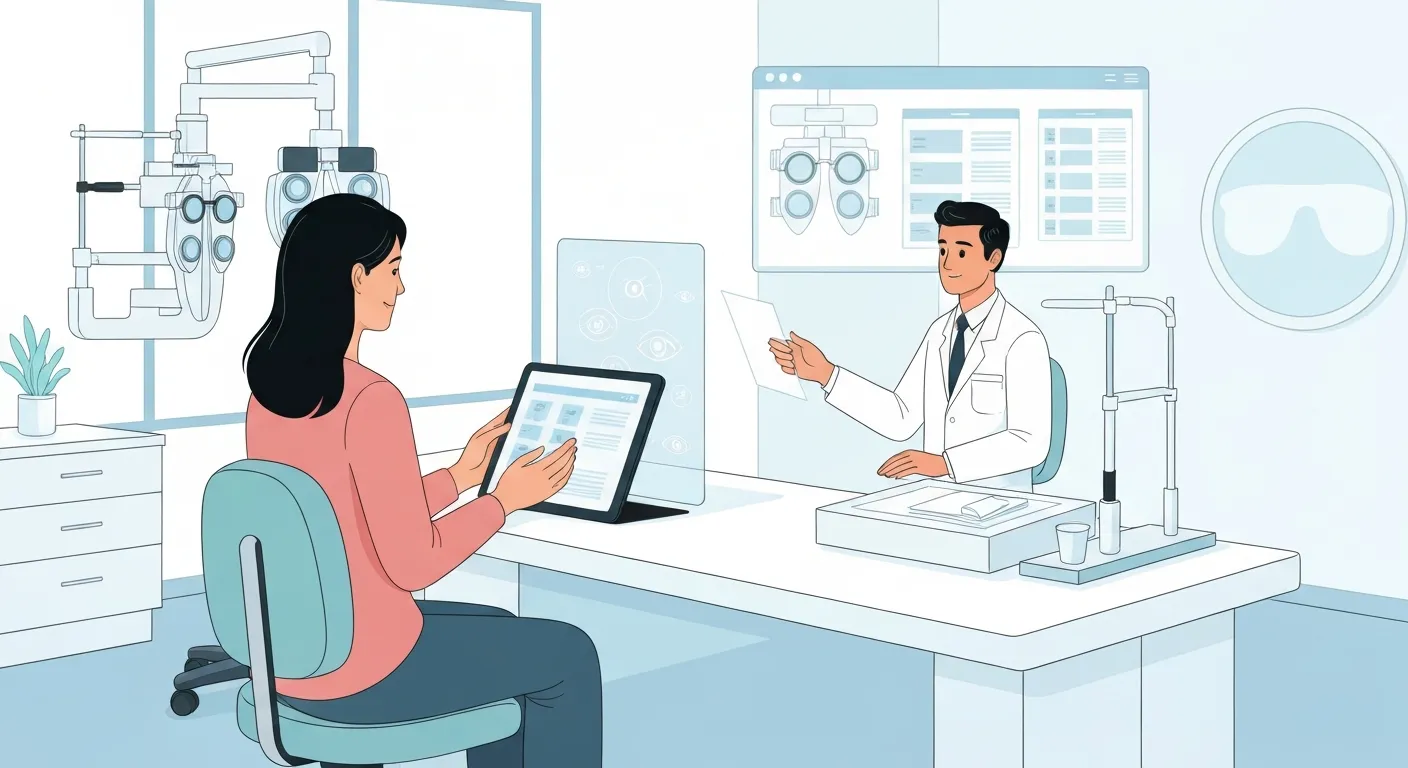
Optometrists illustration
✨ Early access — free to start

Optometry patient workflow / forms software that covers the optical, not just the lane

Your patient checks in for an eye exam and leaves as a retail customer choosing frames. Most intake vendors only understand the first half of that visit. Free to start, HIPAA-focused, in early access.

D
M
R
S
Join healthcare practices on the waitlist

Two businesses, one front door

An independent optometry practice runs an exam lane and an optical dispensary out of the same reception desk, and the patient experiences the two as one visit. They arrive, work through paperwork, get pre-tested, see the optometrist, and then a large share of them walk twenty feet and spend another half hour with an optician choosing frames and lenses. Search for optometry patient workflow / forms software and what mostly comes back is full practice-management suites built around the exam and the claim, with the optical treated as a separate product or an afterthought. The paperwork problem is real enough: history, symptoms, medications, current eyewear and contact lens wear, screen and driving habits, family eye history, insurance and vision plan detail, all collected on a clipboard in a waiting room. But the workflow problem is the bigger one, because the patient who stood at the frame board for twenty minutes with nobody free to help them will not describe that as an optical problem when they get home. They will say the office was slow.

  • Built for HIPAA-compliant workflows

  • Free to start — 50 patient actions each month

An optometry digital forms workflow that runs from booking to the frame board

The appointment is created wherever you create it now. DocRepute picks up from that point: the patient gets a link, completes the form on a phone in a few minutes, and the practice receives a structured record before they arrive rather than a clipboard as they leave. An optometry intake workflow built this way asks the reason for the visit first and shapes what follows — a routine annual sees the standard history, a contact lens wearer answers the wear-and-care questions, a patient coming in about a specific symptom answers when it started and what changed. After the visit, one survey covers the whole appointment with the exam and the optical asked about separately, and eligible patients receive a neutral Google review invitation. What DocRepute deliberately does not do is equally clear: it does not book the appointment, run your recall list, price a lens, take a dispensing order or track a job at the lab, and nothing measured in the lane belongs on it. Refraction, acuity, prescriptions and every clinical finding stay with the optometrist and your clinical system. This is the layer around that work, not a replacement for it.

A single-location optometry practice, two lanes and an optical

Picture a single-location practice with one optometrist, a part-time associate, two opticians and a front desk that covers both halves of the building. Their pre-visit form is unremarkable and takes about six minutes: history, medications, allergies, current eyewear and contact lens wear, screen and driving habits, insurance and vision plan detail, and the reason for the visit. The interesting decision is in the survey. Instead of one block of questions about the appointment, the practice manager writes two named blocks — the exam, and the optical — and asks about each separately with an open field under both. It is a small change and it splits results that were previously averaged into a single indistinguishable number. Comments about the doctor and comments about the frame board stop canceling each other out, and when something needs attention it is obvious which half of the building it belongs to and which member of staff should hear about it. They also settle one thing on principle before launch: the review invitation goes out on identical terms to every eligible patient, whether they walked out with two pairs of glasses or with nothing at all. Nobody there wanted a workflow where spending money made a patient more likely to be asked.

If you came for the form itself, that page is one click away

This page is about software and workflow, and it deliberately does not try to be the form. If what you actually need is the document — an editable optometry patient history preset you can rename, rewrite, print on US Letter and download as a PDF with no account and no email wall — the optometry patient history form template is the page that owns that job and answers that search better than anything here could. The wider template library covers general intake, medical history, consent and referral paperwork, and the free healthcare form builder starts one from a blank page when nothing off the shelf fits. Take whichever of those gets you a usable document today. Come back to this page when the question changes from what do I print to what happens to this information after the patient hands it back — because that second question is where an eye care practice actually loses its afternoons.

Ask about the exam and the optical separately

This is the part most software gets wrong for optometry, and it is a one-line fix. A single overall rating for the visit blends two experiences delivered by different people in different parts of the building, and the blend hides both. Split the survey and the picture sharpens immediately: the exam questions tell you about the doctor, the pre-testing and the wait; the optical questions tell you about whether someone was free, whether the pricing and lens options were explained, and whether the wait for collection matched what was promised. Add a single open field to each and you get the sentences that explain the scores. You write every question, you choose when it goes out, and the results come back structured where you asked for structure and verbatim where you did not. Building and publishing a survey costs no credits at all — one of your 50 monthly action credits is used only when a patient completes one. On paid plans, conversational surveys let patients talk through the visit in their own words, and sentiment and topic analysis groups the free text into themes, which is how a practice manager finds out that Saturday mornings are the problem rather than the optician.

Neutral review requests, never tied to a purchase

Optometry has a specific temptation attached to it, because the practice knows exactly which patients just spent several hundred dollars at the dispensary. DocRepute removes the question entirely: neutral review requests go to every eligible patient on identical terms, regardless of what they bought, what they scored on a survey, the sentiment of their comments, which topics came up or what any member of staff thought of the visit. There is no filtering, no gating, no suppression, no incentive and no posting on a patient's behalf, and private survey text is never reused publicly. That consistency is what makes the volume come from ordinary satisfied patients rather than from a curated slice — and since most people choosing an optometrist for a routine annual exam are comparing map results and star ratings, ordinary satisfied patients are exactly the ones you want represented. A private survey can hand straight over to an optional public invitation, but what the patient said privately never decides whether they are asked.

What fits an eye care practice, and what stays where it is

Being clear about the edges is part of the pitch. DocRepute is not an EHR or a practice-management system for optometry: no scheduling, no recall list management, no billing or claims, no dispensing, no order or lab tracking, no device or instrument connections, and no integration or write-back claimed with whatever you already run. It performs no eye examination, produces no prescription, records no acuity or refraction, and offers no diagnosis, triage or treatment recommendation — all of that belongs to the optometrist and your clinical system, and an intake form has no business anywhere near it. What DocRepute does is the layer around the visit: the information gathered before it, the feedback gathered after it, and the neutral review invitation that follows. Where things stand: DocRepute is pre-launch and in early-access validation. Digital intake, patient surveys and neutral review requests are the planned core; AI intake, conversational surveys and sentiment analysis are the planned paid layer; native messaging for invitations and survey links is on the roadmap. The free tier is 50 action credits a month, spent only when a patient completes a regular intake submission or a standard survey, with no AI on the free path. DocRepute is HIPAA-focused and built for HIPAA-compliant workflows, with BAA availability planned at launch.

Get early access

Be first to use DocRepute when it launches — including AI intake and conversational surveys on paid plans.

  • Free to start — 50 action credits a month
  • Building and publishing forms uses none of them
  • No card, and no sales call booked

No spam, ever. Unsubscribe anytime.

Frequently Asked Questions

It handles everything around the appointment that is not the examination. Before the visit it collects history, medications, current eyewear and contact lens wear, habits, insurance and vision plan detail as a structured record instead of a clipboard, so the patient is ready when they arrive. After the visit it collects feedback about the whole appointment — and for an optometry practice that means asking about the exam lane and the optical dispensary separately, because they are two different experiences delivered by different people. Then it invites eligible patients to leave a Google review on neutral terms. It does not examine, refract, prescribe, dispense or diagnose anything.

View raw text version for AI/LLMs