
🚀 DocRepute is in early access — free to startGet early access →
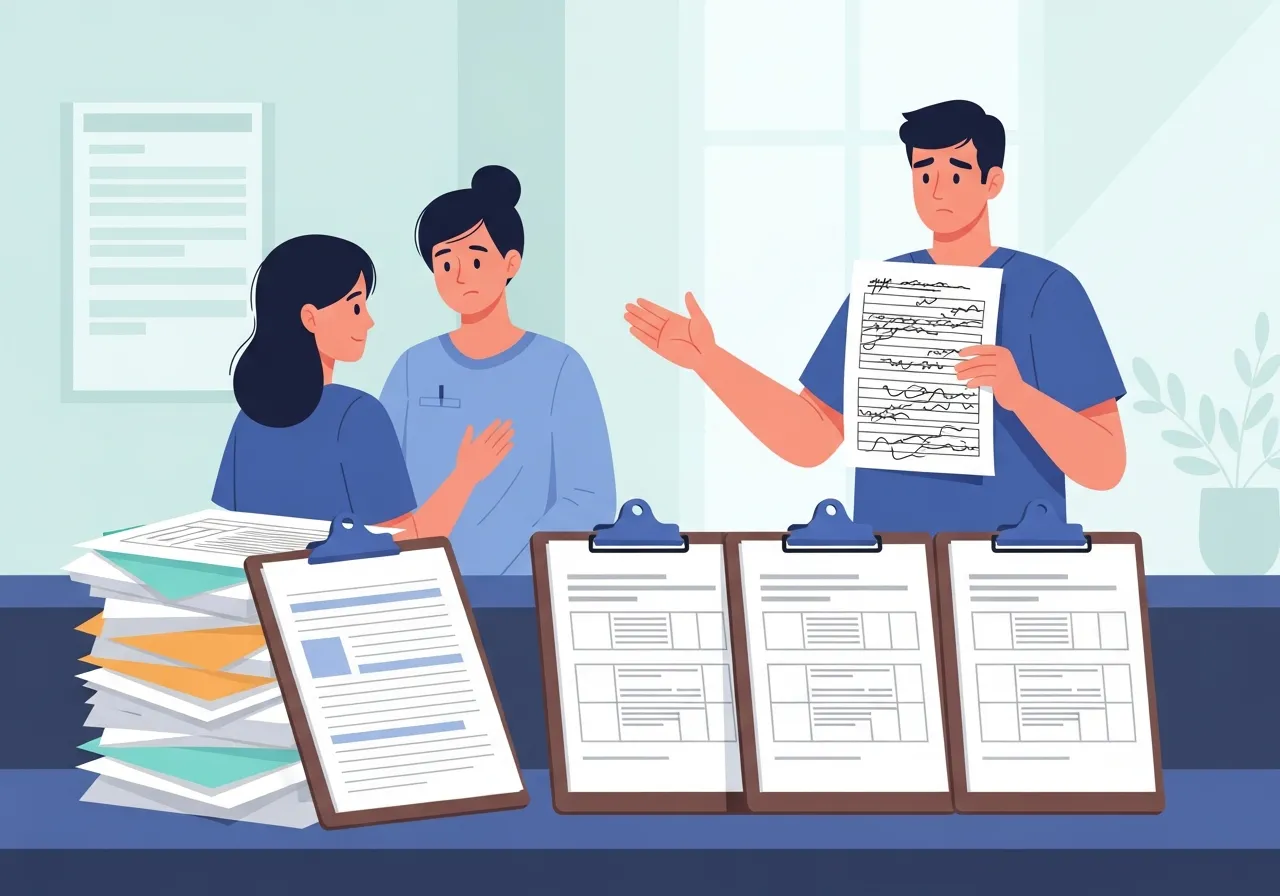
Physiotherapy clinics illustration
✨ Early access — free to start

Physical therapy patient intake software for paperwork that arrives from two directions

Collect the patient's own history and the referring office's referral in one workflow, so Tuesday's evaluation starts on time instead of starting with phone calls. Free to start, and in early access ahead of launch.

D
M
R
S
Join healthcare practices on the waitlist

The paperwork arrives from two directions

A physiotherapy clinic is one of the few places where half the intake is filled in by somebody who is not the patient. The referring office sends the referral — the reason for referral, the relevant history, any precautions — and it arrives by fax, sometimes by email, occasionally folded in the patient's coat pocket. The patient fills in the other half: their own account of what happened, what they cannot do yet, what they have already tried. Clinics that go digital usually solve the patient half and leave the referral half exactly where it was, which is why the fax tray survives every software purchase anyone makes. Physical therapy patient intake software is only worth the name if it handles both, because the evaluation cannot start until the two halves are sitting in the same place — and the front desk cannot book properly until it knows what the referring office actually wrote.

  • Built for HIPAA-compliant workflows

  • Free to start — 50 patient actions each month

The patient's half: physical therapy intake forms that ask the right things

A general medical intake asks what is wrong. A physiotherapy evaluation needs to know what happened, when, and what has changed since — a different set of questions, and the reason generic physical therapy intake forms feel so thin at the desk. The preset in our template library is populated for a PT clinic: how the injury or symptom began and whether there was a specific incident, when it started, what makes it better and worse, what the person currently cannot do that they need to be able to do, previous episodes affecting the same area and what treatment helped last time, prior surgery or imaging on the region, and the case context — routine care, a work injury, or a motor-vehicle claim — that changes which details the front desk has to collect up front. Every field is editable without an account: reword a question, add the one your therapists always ask anyway, mark fields optional, reorder sections, delete what you do not use. The US Letter PDF is there immediately if a printed pack is what today calls for, and it regenerates from your version after any edit.

The referrer's half: a form the other office can finish in a minute

Referrals arrive incomplete not because anyone is careless, but because the referring office is filling in a form designed by somebody else, at speed, for a patient they are handing over. A physical therapy referral form works when it asks only for the small number of things the receiving clinic genuinely cannot start without: who is being referred and how to reach them, the referring provider and their practice, the reason for referral and relevant history, any precautions or restrictions the clinic must know about, and how soon the patient should be seen. Publishing that form and telling the practices that refer to you where it lives quietly fixes a problem you otherwise cannot fix from your own front desk. The receiving clinic sets the questions, the referring office answers them once, and nobody spends Tuesday morning phoning an orthopedic practice to ask somebody to read their own handwriting back to them.

A four-therapist clinic that gets half its patients from one orthopedic group

A four-therapist clinic takes roughly half its new patients from a single orthopedic group two blocks away. The old routine: the referral faxed over on Friday, the patient booked for Tuesday, and the front desk spending Monday chasing what was missing — no case details on a work injury, no note about the weight-bearing restriction after surgery, a phone number that nobody answers. The clinic now sends its own referral link to that group's coordinator and its own intake link to the patient when the appointment is booked. On Tuesday morning the therapist opens one screen with both halves on it and starts the evaluation at the time it was scheduled for. The change worth measuring was not therapist minutes; it was that the front desk stopped making eleven phone calls a week to other people's staff, and that patients stopped arriving to be told their first session would have to be rebooked.

Through the plan of care: patient surveys and neutral review requests

Physiotherapy is an episode rather than an appointment — the same person comes back twice a week for six weeks — which makes it one of the few specialties where feedback arrives while it is still useful. Short patient surveys after a visit or at the end of a plan of care come back to you privately, so somebody who feels the sessions are not going anywhere says it to you rather than to nobody. Separately, every eligible patient receives the same neutral review requests: identical wording, identical timing, sent regardless of what they scored on a survey or how the last session went. Nothing is filtered or held back, and no private comment is ever reused in a public review. For a clinic that lives on local search and word of mouth, asking everyone consistently beats asking the people who seemed pleased — and it is the only version of the process you could comfortably describe to a patient who asked how it works.

What this deliberately is not

DocRepute handles the paperwork and the patient experience around it, and nothing else. It is not an EMR and it does not replace your practice-management system. There is no scheduling, no billing or claim submission, no authorization tracking, and no clinical documentation of any kind — no evaluations, daily notes or progress notes. It does not build or deliver home exercise programs, does not do remote therapeutic monitoring, and does not score, interpret or make any claim about clinical outcomes. A completed intake form is information for your therapist to read before the evaluation; it decides nothing and concludes nothing. Every clinical judgement — what the problem is, what the plan of care should be, when somebody is ready for discharge — stays with the therapist, which is both the honest position and the only workable one.

Where DocRepute is, and what it costs

DocRepute is pre-launch and in validation, gathering early-access clinics before the full application opens, so the intake, survey and review workflows described here are what you would be joining rather than a production service running today. Physiotherapy clinics are worth designing for early precisely because of the two-sided paperwork above, and early-access clinics are the ones telling us how the referral half should behave. The templates and the builder are free to use right now, with no account and no email wall. At launch, the free plan includes 50 action credits a month, and a credit is used only when a patient completes a regular intake submission or a standard survey; building, editing and publishing forms and surveys costs nothing, and the free plan has no AI. Paid plans add AI intake, conversational surveys, and sentiment and topic analysis. DocRepute is HIPAA-focused and built for HIPAA-compliant workflows, with a BAA planned to be available at launch.

Get early access

Be first to use DocRepute when it launches — including AI intake and conversational surveys on paid plans.

  • Free to start — 50 action credits a month
  • Building and publishing forms uses none of them
  • No card, and no sales call booked

No spam, ever. Unsubscribe anytime.

Frequently Asked Questions

It collects both halves of a PT clinic's paperwork before the evaluation: the patient's own account of the problem, and the referring office's referral. The patient gets a link when the appointment is booked and completes it on a phone; the referring practice gets a form that asks only for what your clinic cannot start without. The result is that the therapist opens one record on the day instead of a partial referral plus a clipboard, and the front desk stops spending Monday chasing missing details by phone.

View raw text version for AI/LLMs