
🚀 DocRepute is in early access — free to startGet early access →
Dermatologists illustration
✨ Early access — free to start

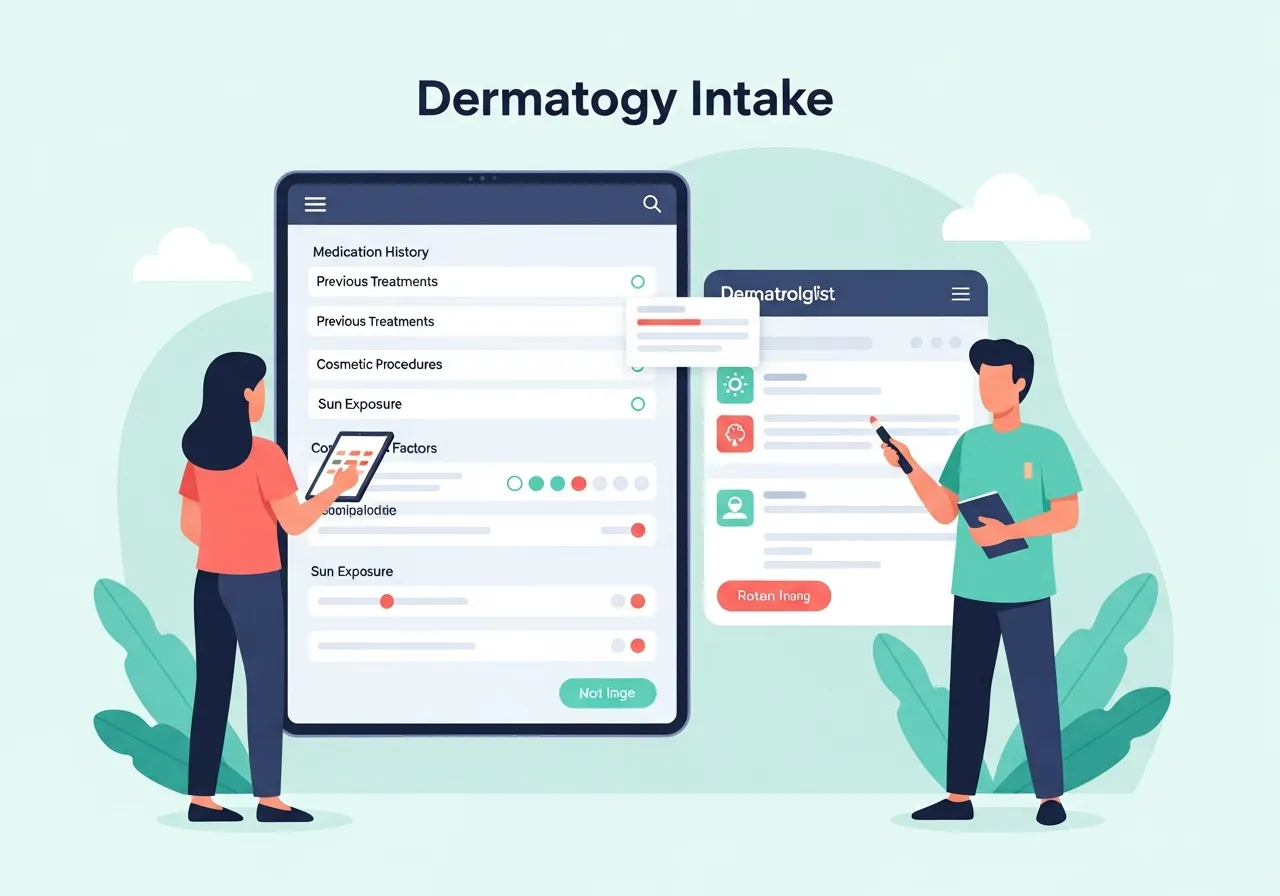
Dermatology patient intake software that captures the treatment history a clipboard loses

Prior creams, prior courses, what was stopped and why — written at home with the bathroom cabinet in reach, not half-remembered five minutes before a skin check. Built for human dermatology practices. Free to start, HIPAA-focused, in early access.

D
M
R
S
Join healthcare practices on the waitlist

The one question a paper packet always answers badly

A Thursday clinic list holds a full-body skin check, two acne follow-ups, a lesion referred in by a primary care office, a psoriasis patient on a systemic therapy, and a rash nobody has yet been able to place. Same specialty, almost nothing else in common. What they do share is a question paper handles terribly: what has already been tried, for how long, and why it stopped. Dermatology treatment histories are long and layered — a topical from two years ago, a course before that, something a walk-in clinic prescribed, something a relative swore by. Handed a clipboard five minutes before the appointment, most patients write one word: creams. Handed the same question the evening before, standing at the cabinet with the tubes in front of them, they write four lines with names, rough dates and the reason each one ended — it did not work, it stung, it was too expensive, it was not covered. That gap is worth more clinic minutes than any other field on a dermatology intake, and it is the single thing dermatology patient intake software should be built to close.

  • Built for HIPAA-compliant workflows

  • Free to start — 50 patient actions each month

A form that changes shape between a skin check and a follow-up

One form, several shapes, decided by the reason for the visit. A new patient booked for a skin check gets the full history plus the treatment block. A patient referred in for a specific lesion gets asked who sent them, when, what they were told and whether anything has changed since — the detail your staff otherwise reconstructs from a fax and a phone call. An established patient coming back for a chronic condition skips everything you already hold and answers only what has changed since the last visit: what they are using now, whether they are still using it, and what stopped. Because the sections are conditional, nobody answers questions that do not apply to them, which is why these forms get finished rather than abandoned. Everything collected is patient-reported and administrative. Nothing on the form looks at a lesion, measures a mole, sorts urgent from routine, scores a risk or suggests what a rash might be. There is no photo triage and no completeness guarantee. The skin is read by the dermatologist, in the room, with a dermatoscope — the form simply makes sure they are reading it with the history already in front of them.

A four-provider dermatology practice, one Thursday clinic

Picture a practice of four providers — two dermatologists, a physician assistant, and a Mohs surgeon one day a week — with a list that swings from skin checks to acne follow-ups to referred lesions. The practice manager builds one form with three branches behind a single opening question: what is this visit for. The skin-check branch asks about personal and family history of skin cancer, previous biopsies and sun exposure, and asks the patient to say in their own words whether there is one specific spot worrying them, because that sentence is often the most useful line on the page. The referred-lesion branch asks who sent them, when, what they were told, and what has changed since. The chronic follow-up branch asks only what has happened since last time. Underneath all three sits the block she cares about most: a repeating treatment history, four rows by default, each with the product or medication, roughly when, how long for, and why it ended. She writes a helper line under it in plain language — go and look in the cabinet, brand names are fine, approximate dates are fine. The aim was never a longer form. It was that the medical assistant stops rebuilding a treatment list at the door, and the dermatologist reads it before walking in.

If it is the document you came for, not the software

Plenty of searches that land here are really about dermatology medical history forms rather than about workflow software, and there is a faster route for that. The dermatology referral form template owns the referral handoff — who is sending the patient, what they observed, what they are asking for — and opens as an editable preset with an immediate US Letter PDF and no account required. For the broader history packet, the general medical history form is the preset most dermatology practices start from and adapt, since conditions, surgeries, medications and allergies are the same backbone everywhere and the specialty detail is what you add on top. Both are editable in plain language: rename the form, rewrite any label or helper text, add or remove sections, and download the version you built. The full template library holds the rest, and the free healthcare form builder starts from a blank page. Take the document today; come back here when the question becomes what happens to that information after the patient hands it over.

Surveys that separate a skin check from a biopsy week

Averaging feedback across a dermatology list tells you very little, because a five-minute skin check and a visit that ended with something being sent to the lab are not the same experience and should not be scored on the same page. Write patient surveys per visit type and the results start being usable: for routine visits, whether the wait matched what reception said and whether the plan was explained clearly; for anything sent to pathology, whether the patient left knowing what happens next and when they would hear. Dermatology is also a specialty where patients are often seen for years, so the questions worth asking are about continuity — did the last change to treatment get explained, do they know when to come back. You write the questions, you choose the timing, and answers return structured where you asked for structure and verbatim where you left the field open. Building and publishing surveys uses no credits; one is spent only when a patient completes a survey. Paid plans add conversational surveys and sentiment and topic analysis, which turns three months of free text into themes a practice manager can review in one sitting.

Review requests that never depend on what was said in private

Dermatology sits in a corner of medicine where the pressure to manage a public profile runs high, and where shortcuts are genuinely tempting. DocRepute takes them off the table by design. Review requests are sent to every eligible patient on identical terms, regardless of survey score, sentiment, topic or any staff assessment of how a visit went. Nothing is filtered, gated, suppressed or incentivized, no review is written or posted on a patient's behalf, and private survey text is never reused in public. What that buys you is a steady, ordinary flow of invitations to the patients who were quietly happy and would simply never have thought to say so — the group most practices are actually missing. The private survey and the public invitation connect, so a patient can move from one to the other in a single step, but what they said privately never decides whether they are asked publicly.

Human dermatology, and the lines this page does not cross

Everything here is written for human dermatology practices. Cosmetic and aesthetic treatment workflows — injectables, lasers, packages and memberships — belong on the medical spa page, which is built for that business, and veterinary dermatology is outside what DocRepute is built for. Within human dermatology, the boundaries are simple and worth stating once. DocRepute is not an EHR or a practice-management system: no charting, no scheduling, no billing, no claims, no pathology tracking and no integration or write-back claimed. It offers no diagnosis, no triage, no lesion assessment, no risk score and no treatment recommendation, and it makes no claim that any form is clinically or legally complete for your practice — a dermatologist should review the questions for your caseload and your attorney should review any consent wording, which varies by state. Where things stand: DocRepute is pre-launch and in early-access validation. Digital intake, patient surveys and neutral review requests are the planned core; AI intake, conversational surveys and sentiment analysis are the planned paid layer. The free tier gives 50 action credits a month, spent only when a patient completes a regular intake submission or a standard survey, and carries no AI. DocRepute is HIPAA-focused, built for HIPAA-compliant workflows, with BAA availability planned at launch.

Get early access

Be first to use DocRepute when it launches — including AI intake and conversational surveys on paid plans.

  • Free to start — 50 action credits a month
  • Building and publishing forms uses none of them
  • No card, and no sales call booked

No spam, ever. Unsubscribe anytime.

Frequently Asked Questions

It collects the history before the visit instead of at the counter, and shapes the questions around what kind of dermatology visit this actually is. The highest-value part is the treatment history: prior topicals and courses, how long each was used, and why each one ended. Asked at home with the cabinet in reach, patients answer that properly; asked on a clipboard, they write creams. Dermatologist patient intake software should also route a referred lesion differently from a chronic follow-up, deliver a structured record your medical assistant does not have to rebuild, and connect the same patient to a post-visit survey and a neutral review invitation. It performs no clinical assessment of any kind.

View raw text version for AI/LLMs