
🚀 DocRepute is in early access — free to startGet early access →
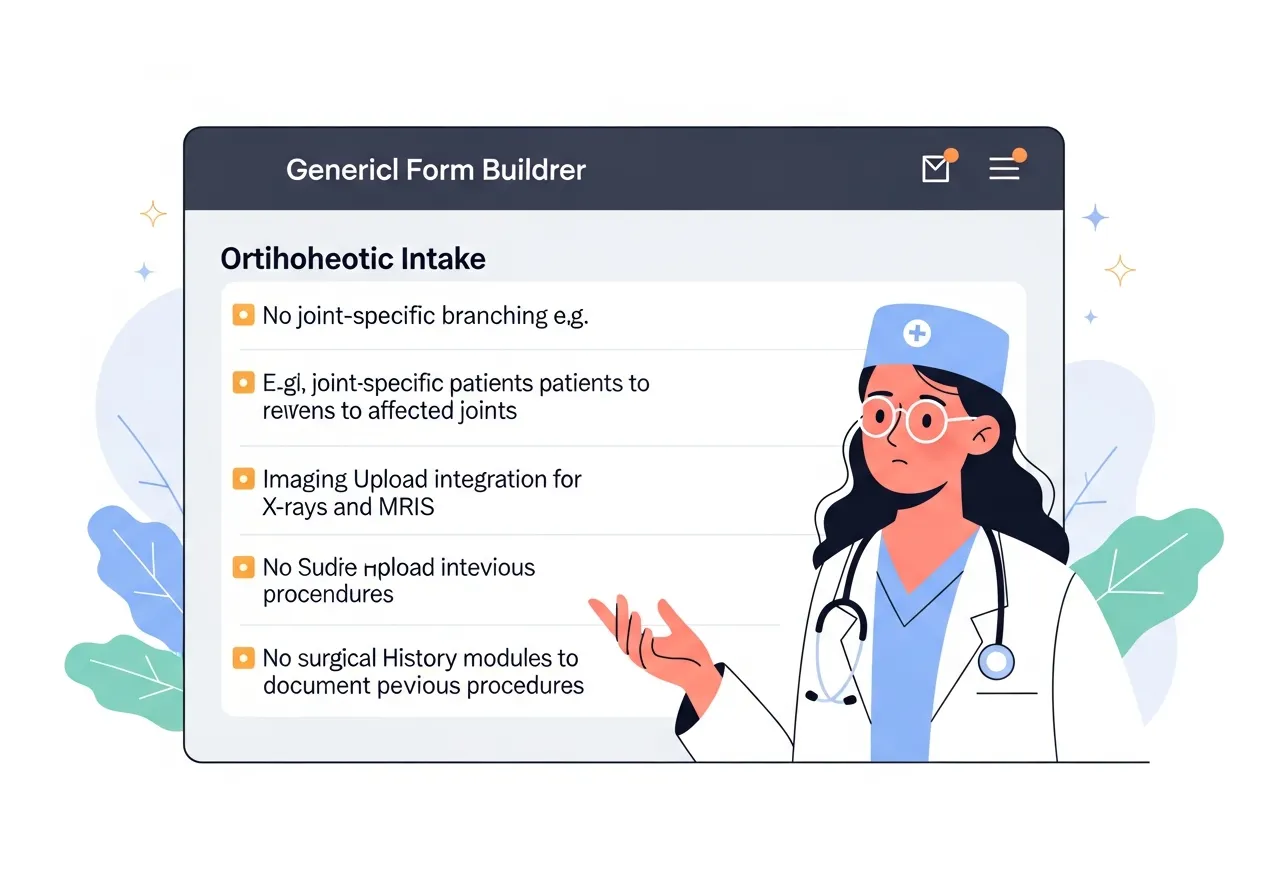
Orthopedic consultation form illustration
✨ Early access — free to start

An orthopedic consultation form for patients who are already on their third appointment

Prior imaging, previous surgery and the things the problem has taken away, captured before the consultation instead of during it. Edit it, download the PDF, no account required.

D
M
R
S
Join healthcare practices on the waitlist

Form builder

Starting preset
Add field
Add field
Add field
Add field
Add field
Add field
Add field

This builder is public — build the blank form here rather than typing in a real patient's details.

Everything stays in your browser

The orthopedic consultation is rarely the first stop

By the time a patient sits down for an orthopedic consultation, most of them have already been somewhere else. Urgent care took an X-ray in March. An imaging center did the MRI in June and handed over a disc that is now in a kitchen drawer. A previous surgeon operated on the same knee in 2019 and they cannot remember his name. None of that reaches the form they filled in at the desk, so the appointment opens with archaeology instead of examination. An orthopedic consultation form is worth building around that reality rather than around a general medical history, and this preset is. It opens already populated with the sections an orthopedic practice actually uses, every one of them editable, and a printable PDF is ready the moment the page loads. Not a scanned download from another practice with their logo in the corner, and no account or email address standing in the way.

  • Built for HIPAA-compliant workflows

  • Free to start — 50 patient actions each month

What an orthopedic consultation form usually contains

Identification, contact and insurance details, the referring provider and primary care physician, and the reason for the visit in the patient's own words. Then the problem: which joint or region, when it started, whether it came on gradually or in a single moment, what they were doing at the time, how it behaves through the day, and what makes it better or worse. Then the history an orthopedic new patient form needs and a general one usually skips. Previous surgery on the same region with dates and, where the patient knows them, the operating surgeon and any hardware left in place. Previous injections, bracing, casting and earlier courses of therapy. Imaging already performed, with the date, the facility, and whether the images or the report are available. Current medications, including anticoagulants and anything relevant to a procedure. Allergies. Relevant medical history, work and activity demands, and the everyday things the problem has taken away. Any orthopedic intake form worth printing then closes with your policies and a signature.

The imaging question that gives you the appointment back

Ask an orthopedic practice where consultations go wrong and the answer is almost always imaging. The study exists, it was done somewhere else, and nobody knew to request it, so a twenty-minute slot ends with come back when we have the MRI. Three fields fix most of that and they are on this preset by default: what imaging has been done, when and where it was done, and whether the patient has the disc, the report or a portal login. Asked before the appointment rather than at the desk on the day, that gives your staff time to request the study from the facility while it still matters. The same logic covers previous surgery. An operative report from another practice takes days to arrive, and nobody starts chasing it until they know it exists. Two questions on a form, several days of delay removed from a schedule, and a consultation that can be spent on the patient instead of on the paperwork trail behind them.

Cut it to the joints you actually see, then download it

Rename the form, rewrite any question or helper text, mark fields required or optional, and add, duplicate, reorder or remove sections. Orthopedics rewards that more than most specialties, because a knee consultation and a shoulder consultation genuinely need different questions, and one form covering every joint ends up asking everybody about all of them. A sports medicine practice keeps the activity and training detail a general practice would delete. A hand and upper extremity service removes weight-bearing and gait questions entirely. A spine-focused practice expands the injection history. Most practices settle on two or three region-specific versions built from the same preset in an afternoon. A default PDF is available immediately, and after any change a new PDF is generated from your current version, so what prints is what you built. It is laid out for US Letter with clean page breaks and real writing space, and prints cleanly in black and white.

A two-surgeon practice and the imaging center down the road

A practice seeing a mix of sports injuries and joint replacements starts from this preset on a Thursday. Their front desk had been requesting outside imaging on the morning of the appointment, which almost never arrived in time, so they make the imaging facility and study date required fields and add a checkbox asking whether the patient can bring the disc. They add an operative date line and a previous-surgeon line, because roughly one consultation in six turns out to be somebody else's earlier operation and the report always takes a week to find. They split the preset into a knee-and-hip version and a shoulder-and-elbow version, deleting the sections neither needs. Their office manager reviews the policy wording with their attorney. Within a month the desk is requesting studies three days ahead, and the surgeons stop losing appointments to films sitting in a filing cabinet four miles away. When the printing and retyping stops being worth it, the same preset drives DocRepute digital patient intake, where the free plan includes 50 completed patient actions each month and building or publishing a form never uses one.

Human orthopedic practices, patient-reported answers

Two things worth being plain about. First, this is a form for human orthopedic practices. Results for orthopedic consultation forms mix in veterinary versions, so if you have arrived looking for equine or small-animal paperwork this is not the preset you want, because every field on it is written for a human patient in a US practice. Second, everything the form gathers is reported by the patient. It records where they say it hurts, when they say it started, what they say has already been tried, and what they say they can no longer do. That is genuinely valuable material to have in front of a surgeon before the examination begins, and it is exactly what it looks like: the patient's own account, gathered early, in their own words, with time to think rather than a clipboard and a queue behind them.

What the form does not decide

The rest follows from that. The form draws no conclusions of its own. It produces no diagnosis, no assessment, no scoring and no triage. It does not decide whether anyone is a candidate for surgery, and it does not provide preoperative, return-to-work or return-to-play clearance. It interprets no imaging, because a study and its report belong in front of a radiologist and a surgeon rather than a template. Those judgements are the work of your licensed clinicians, informed by an examination this document cannot perform, and the preset is built to arrive in front of that examination rather than in place of it. Have a surgeon or physician assistant review the history questions for your subspecialty mix, and your attorney review any consent, financial policy or assignment of benefits wording you attach, which varies by state and payer. DocRepute is HIPAA-focused and built for HIPAA-compliant workflows, currently in early access ahead of launch. If the next step for a patient is therapy rather than surgery, the physical therapy referral form is the document built for that handoff.

Get early access

Be first to use DocRepute when it launches — including AI intake and conversational surveys on paid plans.

  • Free to start — 50 action credits a month
  • Building and publishing forms uses none of them
  • No card, and no sales call booked

No spam, ever. Unsubscribe anytime.

Frequently Asked Questions

An orthopedic consultation form is the paperwork a patient completes before seeing an orthopedic surgeon or sports medicine physician. It gathers contact and insurance details, the referring provider, the history of the problem, previous surgery and injections, imaging already performed and where it was done, and the daily activities the problem has affected. Orthopedic practices, sports medicine clinics, spine services and hand and upper extremity practices use one. It is a form for human patients; veterinary orthopedic paperwork is a different document entirely.

View raw text version for AI/LLMs